
ABOUT OUR HISTORY
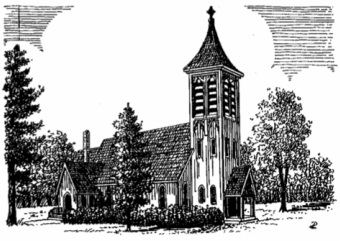
St. James Episcopal Church began in 1853 as a “religious society” which met in a local schoolhouse. Joel L.G. Smith soon donated two acres of land, and by 1854 a church building was completed. Recording local history in 1882, Judge J. Lawrence Smith wrote that the church was called St. James “in complement to James Clinch through whose instrumentality and liberality the church was organized and in its infancy, mainly supported.”
The first service took place on July 3, 1854, when the church building was consecrated. Within a short time a rectory was built and a cemetery laid out. The vestibule, tower and louvered belfry were added to the church in 1877, and the pulpit was added a year later. The U.S. Post Office chose to honor the church by adopting the name “St. James” for the hamlet. To the best of our knowledge, it is the only village in New York named after a church.
Three of the well-documented stained glass windows were designed by noted architect Stanford White (who is interred in the cemetery) and fabricated by John La Farge. Another window was designed by Louis Comfort Tiffany and manufactured by Tiffany Glassworks. The church is listed in the St. James National Register Historic District and has received state and local building preservation awards.
A much-needed campaign of restoration and repair began in 1990 and was completed in 1994. Conducted with the assistance of a professional fund raising consultant, this capital campaign resulted in nearly $500,000 given by more than 140 parishioners and community supporters. This permitted a full restoration of the exterior of the church, a new cedar shingle roof, restoration of the handpainted Sanctuary window, and landscaping of the grounds. Following this campaign, the church won an award from the Society for the Preservation of Long Island Antiquities (1997) that heightened its status as a community landmark.
Through a series of events spanning July 2003 to June 2004, the parish celebrated its 150th anniversary, seeking both to remember our heritage and to anticipate God's direction for our future. The sesquicentennial was launched with an Evensong using the 1789 Book of Common Prayer and the King James Bible, followed by an old- fashioned Sunday Social. Other events in the year-long celebration included a Community Open House with tours of our church building and an organ concert featuring the works of J. S. Bach and Buxtehude, followed by an English High Tea; a Family Country Picnic and Pig Roast; the presentation of a hand-made quilt with signatures and messages from parish families; a Gala Dinner Dance; and the production of a 150th Anniversary Journal containing historic timelines and congratulatory messages from parishioners and the greater community. The sesquicentennial concluded with a service of Rededication of the Church, the consecration of the Biblical Garden and cemetery extension, and a special coffee hour.
The Very Rev. Canon Dr. Raewynne J. Whiteley was our Rector from January 2007 to December 2017. During her time with us, we discerned that God was calling us as a parish to grow in faith through scripture and prayer, to build relationships in Christ, and to serve one another and the world. We grew significantly in numbers of families with young children, watched our children flourish with the Godly Play program , saw the expansion of the food pantry, and started a major renovation of our facilities so that they will sustain our ministry well into the future.
As we seek a new Rector, we continue to thrive, growing deeper in our faith will looking ever more outwards to serve a world in need of hope.
The first service took place on July 3, 1854, when the church building was consecrated. Within a short time a rectory was built and a cemetery laid out. The vestibule, tower and louvered belfry were added to the church in 1877, and the pulpit was added a year later. The U.S. Post Office chose to honor the church by adopting the name “St. James” for the hamlet. To the best of our knowledge, it is the only village in New York named after a church.
Three of the well-documented stained glass windows were designed by noted architect Stanford White (who is interred in the cemetery) and fabricated by John La Farge. Another window was designed by Louis Comfort Tiffany and manufactured by Tiffany Glassworks. The church is listed in the St. James National Register Historic District and has received state and local building preservation awards.
A much-needed campaign of restoration and repair began in 1990 and was completed in 1994. Conducted with the assistance of a professional fund raising consultant, this capital campaign resulted in nearly $500,000 given by more than 140 parishioners and community supporters. This permitted a full restoration of the exterior of the church, a new cedar shingle roof, restoration of the handpainted Sanctuary window, and landscaping of the grounds. Following this campaign, the church won an award from the Society for the Preservation of Long Island Antiquities (1997) that heightened its status as a community landmark.
Through a series of events spanning July 2003 to June 2004, the parish celebrated its 150th anniversary, seeking both to remember our heritage and to anticipate God's direction for our future. The sesquicentennial was launched with an Evensong using the 1789 Book of Common Prayer and the King James Bible, followed by an old- fashioned Sunday Social. Other events in the year-long celebration included a Community Open House with tours of our church building and an organ concert featuring the works of J. S. Bach and Buxtehude, followed by an English High Tea; a Family Country Picnic and Pig Roast; the presentation of a hand-made quilt with signatures and messages from parish families; a Gala Dinner Dance; and the production of a 150th Anniversary Journal containing historic timelines and congratulatory messages from parishioners and the greater community. The sesquicentennial concluded with a service of Rededication of the Church, the consecration of the Biblical Garden and cemetery extension, and a special coffee hour.
The Very Rev. Canon Dr. Raewynne J. Whiteley was our Rector from January 2007 to December 2017. During her time with us, we discerned that God was calling us as a parish to grow in faith through scripture and prayer, to build relationships in Christ, and to serve one another and the world. We grew significantly in numbers of families with young children, watched our children flourish with the Godly Play program , saw the expansion of the food pantry, and started a major renovation of our facilities so that they will sustain our ministry well into the future.
As we seek a new Rector, we continue to thrive, growing deeper in our faith will looking ever more outwards to serve a world in need of hope.
RECTORS OF ST JAMES EPISCOPAL CHURCH
|
1853-1859
1860-1868 1868-1870 1870-1872 1874-1875 1876-1880 1880-1900 1900-1928 1928-1935 1936-1967 1967-1970 1970-1980 1981-1989 1990-1997 1999-2004 2007-2017 |
Carlton P. Maples
Charles S. Williams John W. Bookmaster Henry V. Degen James H. Lee Ingraham W. Irvine John Q. Archdeacon William Holden John C. Runkle Joseph E. Mills Peter D. MacLean McCrea H. Cobb Donald A. Webster Richard A. Burnett Michael E. Bartolomeo Raewynne J. Whiteley |